
Path of Exile Blight Farming Guide: Corrupted Core Maps and Tower Control
Learn how to combine narrow Blight lanes, strongboxes, and altar rewards into a manageable T16 farming strategy.
Overview
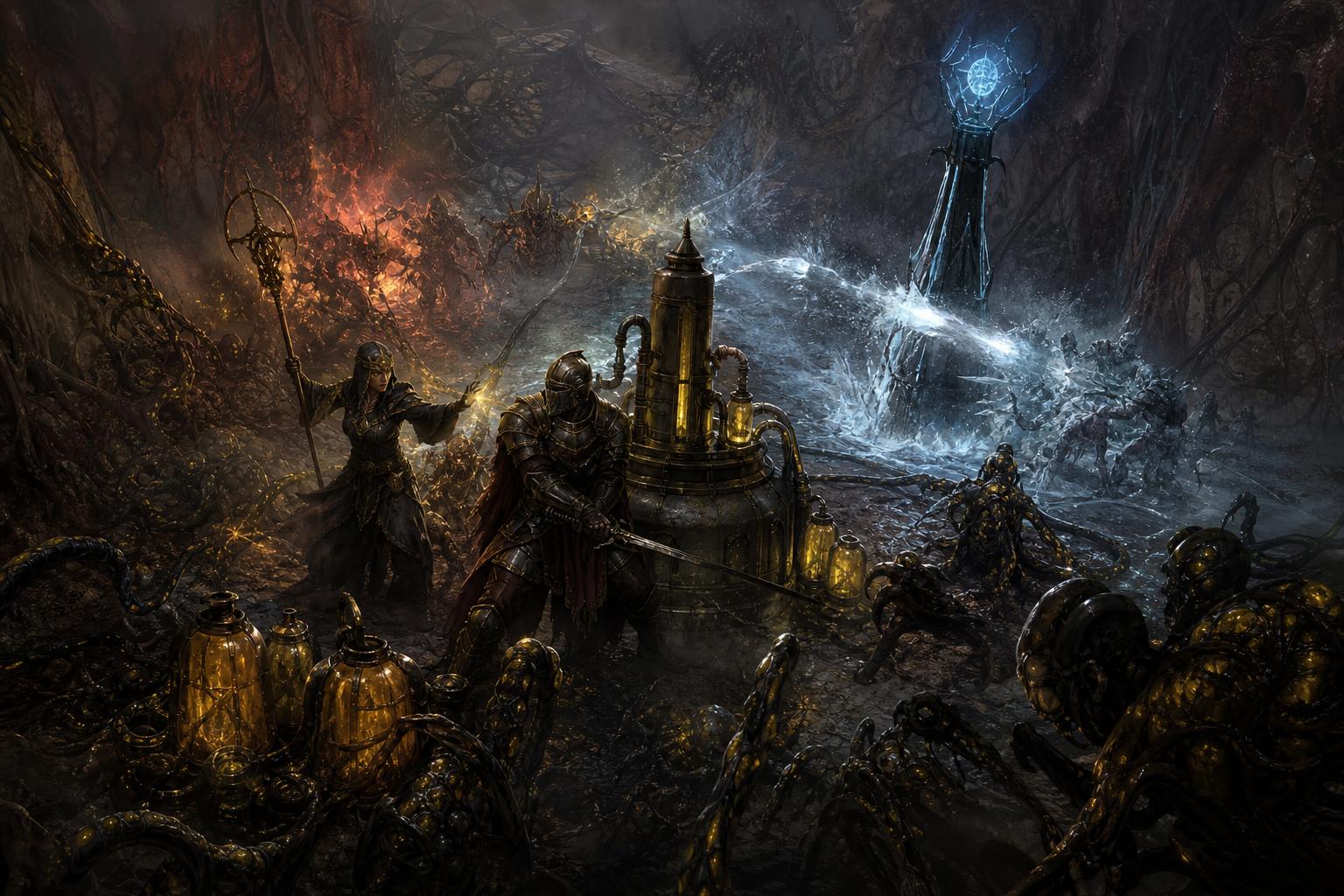
Blight farming in Path of Exile rewards more than raw damage. Map layout, tower placement, and the order in which encounters are completed can make the difference between a controlled defence and an expensive failure. This guide explains a corrupted T16 Core Map strategy that combines Blight, strongboxes, and Searing Exarch altars, with practical advice on rewards, freezing towers, and difficulty management.
How the Blight Farming Strategy Works
The foundation is straightforward: run corrupted tier 16 maps, invest heavily into Blight and strongboxes on the Atlas passive tree, and use red altars to add rewards while clearing. Core is the preferred layout because its restrictive passages can produce Blight encounters with fewer lanes.
Fewer lanes make tower coverage easier and can concentrate rewards into a smaller number of paths. A single-lane encounter is particularly desirable because its reward allocation can be concentrated into Blight rewards rather than spread across multiple reward types.
This is a combined mapping strategy, not simply a race to Sister Cassia. Clearing the surrounding map first creates opportunities to collect altar benefits and strongbox loot before committing to the main defence.
- Main encounter: Blight inside regular maps.
- Map choice: Corrupted T16 Core maps with manageable modifiers.
- Supporting mechanics: Strongboxes and Searing Exarch altars.
- Control tool: A ring anoint that lets chilling towers freeze enemies.
- Loot focus: Oils, Blighted Maps, currency, and additional encounter rewards.
Preparing Maps and Your Atlas
Prioritise Blight and strongbox passives
Build the Atlas around the two mechanics the strategy actually uses. Blight investment supports the encounter and its rewards, while strongbox investment adds another source of loot throughout the map.
Strongboxes also have direct overlap with Blight through Blight-themed rewards. That overlap makes them a more coherent partner than adding several unrelated mechanics that each require separate investment and attention.
There is no need to invent a rigid point-by-point tree. Allocate the relevant clusters available to your Atlas, retain enough map sustain for continued farming, and avoid spreading points across content that slows the route without contributing meaningful returns.
Why corrupt the maps?
Corrupted maps provide access to Tainted Oil as a potential Blight reward. Corruption does not guarantee a drop, so treat it as access to an additional valuable outcome rather than a predictable payment for every encounter.
Prepare several maps at once and inspect their modifiers before opening them. A corrupted map cannot be rerolled through the usual methods, and dangerous combinations can undermine an otherwise reliable setup.
Track preparation costs separately from gross loot. Sustainable Path of Exile currency farming depends on what remains after paying for maps and other consumables, not just the best item visible on the ground.
Why Core Works for Blight
Core's narrow geometry is the main attraction. Blight paths must fit the available terrain, and restrictive passages can lead to encounters with fewer lanes than more open layouts.
This is a tendency, not a guarantee. Some encounters still branch or produce awkward tower positions. Evaluate the actual paths before spending resources, rather than assuming every Core map will offer an ideal defence.
A compact encounter has two practical advantages. First, fewer approaches are easier to monitor. Second, several useful towers can cover the same stretch of enemies, making control more dependable.
The map boss is not essential to the basic farming loop. Skipping Core Malachai can save time when the objective is repeatable Blight and strongbox rewards. However, complete the boss when needed for Atlas progression or when another reward objective makes the fight worthwhile.
Take a look at: Atlas progression from early Blight to red maps
Clear the Map Before Starting Blight
Rather than activating Cassia immediately, clear the surrounding map and resolve suitable altars first. This creates space around the encounter and lets useful map-wide altar effects apply before the defence begins.
Altar choices still require judgment. Additional rewards are not worthwhile if their accompanying downside makes the character unable to survive the encounter.
- Clear nearby packs so they cannot interfere during tower construction.
- Open strongboxes when their modifiers are safe for the character.
- Read altar rewards and downsides before selecting them.
- Return to Cassia after collecting worthwhile benefits.
- Inspect the lanes and tower positions before starting the defence.
Keep reward interactions distinct. Item rarity, item quantity, currency duplication, and fixed encounter rewards are not interchangeable mechanics. Do not assume that a rarity bonus automatically improves every oil chest or converts ordinary currency into higher-value orbs.
Rushing straight to Blight is an alternative for characters optimised around encounter speed. However, it gives up some of the supporting value that makes this full-map approach attractive.
Using Chilling Towers to Control the Encounter

The freezing ring anoint
A key defensive tool is the ring anoint that allows chilling towers to freeze enemies. The combination uses a Silver Oil and an Opalescent Oil. Confirm the displayed anoint effect with Cassia before applying it.
This creates a control layer that buys time for damage towers and the character's own skills. It is especially useful when multiple enemy groups must pass through the same narrow section.
Placement matters more than tower quantity
Look for positions that cover a shared approach to the pump. A well-placed control tower can contribute more than several towers scattered across paths where they rarely affect the same enemies.
Do not rely on a single tower type to solve every encounter. Lane resistances, map modifiers, and enemy behaviour can interfere with a preferred setup. Add complementary damage or control where necessary, and remain close enough for the defensive network to function.
Players with strong builds can kill monsters as they emerge, but personal damage should reinforce the tower plan rather than replace it. A sudden boss wave or dangerous rare enemy can expose a defence that appeared comfortable against ordinary packs.
Scaling Difficulty Without Losing Consistency
When additional Thread difficulty options are available, begin with a level the character handles reliably. Increasing from one Thread to three is a difficulty decision, not an automatic improvement to profit.
Additional encounters and reward interactions can create substantial upside. Mirage interactions can provide another Blight encounter, while special strongbox-related interactions may add further rewards. Treat these as bonuses when available, not as outcomes required for the strategy to work.
Change one variable at a time. Establish a baseline with the same map tier and Atlas setup before increasing difficulty. If failures become common, reduce the added pressure before spending more on upgrades.
Deaths can be abrupt even when ordinary packs feel harmless. Maintain the build's core defences, avoid standing on dangerous corpses, and watch for boss attacks rather than focusing entirely on reward icons.
Take a look at: how Thread difficulty and rewards interact
Evaluating Loot and Reinvestment
Judge the strategy across a batch of maps. A Divine Orb drop or a valuable duplicated reward can distort the apparent return from a short sample, while several modest encounters may still contribute useful oils and other saleable items.
- Record costs: Maps, preparation materials, and encounter consumables.
- Separate reward categories: Oils, Blighted Maps, currency, and other items.
- Account for failures: Lost encounters and repeated deaths reduce efficiency.
- Measure time: Include looting, sorting, and preparing the next map.
Use early profits to fix the weakest part of the setup. The freezing anoint, essential defensive gear, or a meaningful damage upgrade will often contribute more than immediately increasing map investment.
A useful PoE currency budget leaves enough resources to keep running maps after an unlucky stretch. Avoid tying the entire farming bankroll to one ambitious encounter.
FAQ
Is Core guaranteed to produce one Blight lane?
No. Its restrictive layout encourages compact encounters, but lane count and tower positions still vary.
Why use corrupted T16 maps?
Corruption enables Tainted Oil to appear among eligible Blight rewards. It does not guarantee the oil, and map modifiers must still suit the build.
Should the map boss always be skipped?
No. Skipping can improve the farming loop's speed, but boss completion remains worthwhile for progression or another relevant reward objective.
Do I need enough damage to kill everything myself?
No. Towers provide substantial control and damage. The character still needs sufficient survivability and damage to handle enemies that escape the tower network.
Should I immediately use the highest Thread difficulty?
No. Increase difficulty only after the basic setup is consistent. Reliable completions are a stronger foundation than occasional large rewards offset by frequent failures.