
WoW Forever Dungeon Lore Guide: Four Adventures and Their Hidden Stories
Discover the stories, faction differences, and easily missed quest details inside four dungeon adventures.
Overview
World of Warcraft Forever's dungeons tell stories through more than their final bosses. Tomb inscriptions, recovered letters, excavation finds, and faction-specific assignments reveal conflicts that a quick clear can easily overlook. This guide explores four adventures, explaining why players enter them and which discoveries give each journey its meaning. Story spoilers follow, including the outcome of the Heartweaver family quests.
Hall of Thanes: Disturbing Ironforge's Ancestors
The Hall of Thanes begins with a threat beneath familiar ground. Alliance adventurers fighting Dark Iron spies in Dun Morogh discover a map showing tunnels beneath Ironforge. Those passages lead to sealed ancestral halls that a Dark Iron looting expedition has breached.
Led by Durg and Durg Hammer, the intruders use enormous drilling machines to break into the tombs. Their intrusion does more than expose valuable burial goods: it awakens the spirits of the dwarven dead. Stopping the expedition therefore means defending both Ironforge's history and the ancestors whose rest has been disturbed.
Why the Tombs Matter
The hall's occupants connect dwarven history to the city and surrounding lands. Modimus Anvilmar, the last High King of the dwarves, is among the figures commemorated here. Other graves bear names associated with places across Khaz Modan, making the dungeon a useful place to notice how geography preserves ancestral memory.
The most revealing memorial belongs to Muradin Bronzebeard. His presence among the honored dead reflects what Ironforge believes happened to him, rather than proof of his death. After Arthas claimed Frostmourne, Muradin was left wounded and presumed dead. His people do not know that he survived.
That distinction changes how the tomb should be understood. It is a monument to loss built from incomplete knowledge, and an example of how characters' beliefs shape the world players explore.
The Treaty of Understanding
Near the end of the dungeon, players can recover the Treaty of Understanding, a stone tablet recording a peace agreement following the War of the Three Hammers. Unlike an ordinary piece of treasure, it places the fighting within the longer history of relations between the dwarven clans.
The dungeon also introduces a deliberate contradiction: adventurers stop grave robbers while a gnome outside offers rewards for collecting priceless dwarven artifacts. Paying attention to that assignment makes the expedition less morally tidy than simply defeating thieves.
- Read the names attached to tombs instead of treating them as decoration.
- Watch for the Treaty of Understanding near the dungeon's conclusion.
- Consider how artifact-recovery quests resemble the looting players are sent to stop.
The Ruins of Lordaeron: Reclamation and Unfinished Lives
Above the Undercity, the Forsaken have not yet secured the streets of their former capital. The necromancer Rathmael conceals hostile undead beneath supernatural fog, turning the ruins and graveyard into a continuing threat. Defeating him helps the Forsaken reclaim their home from the Scourge.
Both factions have reasons to enter, but their assignments emphasize different relationships with the dead. Alliance players recover military insignia for surviving relatives. Horde players receive a request from the Forsaken paladin Marden Lightbane to gather intact limbs as replacements for wounded and slain Forsaken soldiers.
One task preserves identities and family connections; the other addresses the practical needs of people living in undead bodies. Together, they establish the dungeon's central theme: Lordaeron's destruction did not end its inhabitants' obligations to one another.
The Baron and Garithos
An abomination called the Baron carries the head of Grand Marshal Othmar Garithos. After Sylvanas had him killed, his remains were incorporated into an abomination. Repeated destruction and reconstruction have not made him a reliable servant, and the creature has gone rogue.
Horde players deliver his head to Apothecary Faranell and help attach it to another body. When Garithos refuses to cooperate, a serum is prepared to enforce loyalty. The quest turns a former commander into a grotesque instrument of the people he despised.
Alliance players encounter a different expression of the same irony. They deliver the head to a delusional Forsaken who believes he is still alive and awaits Garithos's return. He refuses to recognize the remains, clinging to a vision of reclaiming Lordaeron from nonhumans while failing to recognize his own condition.
The Heartweaver Family's Divided Story
The dungeon's most affecting storyline begins with Tabitha Heartweaver in Silverpine. She and her husband Edward lost their son Jeremy during Lordaeron's destruction. They never found his body, and Edward continues searching even after being raised into undeath.
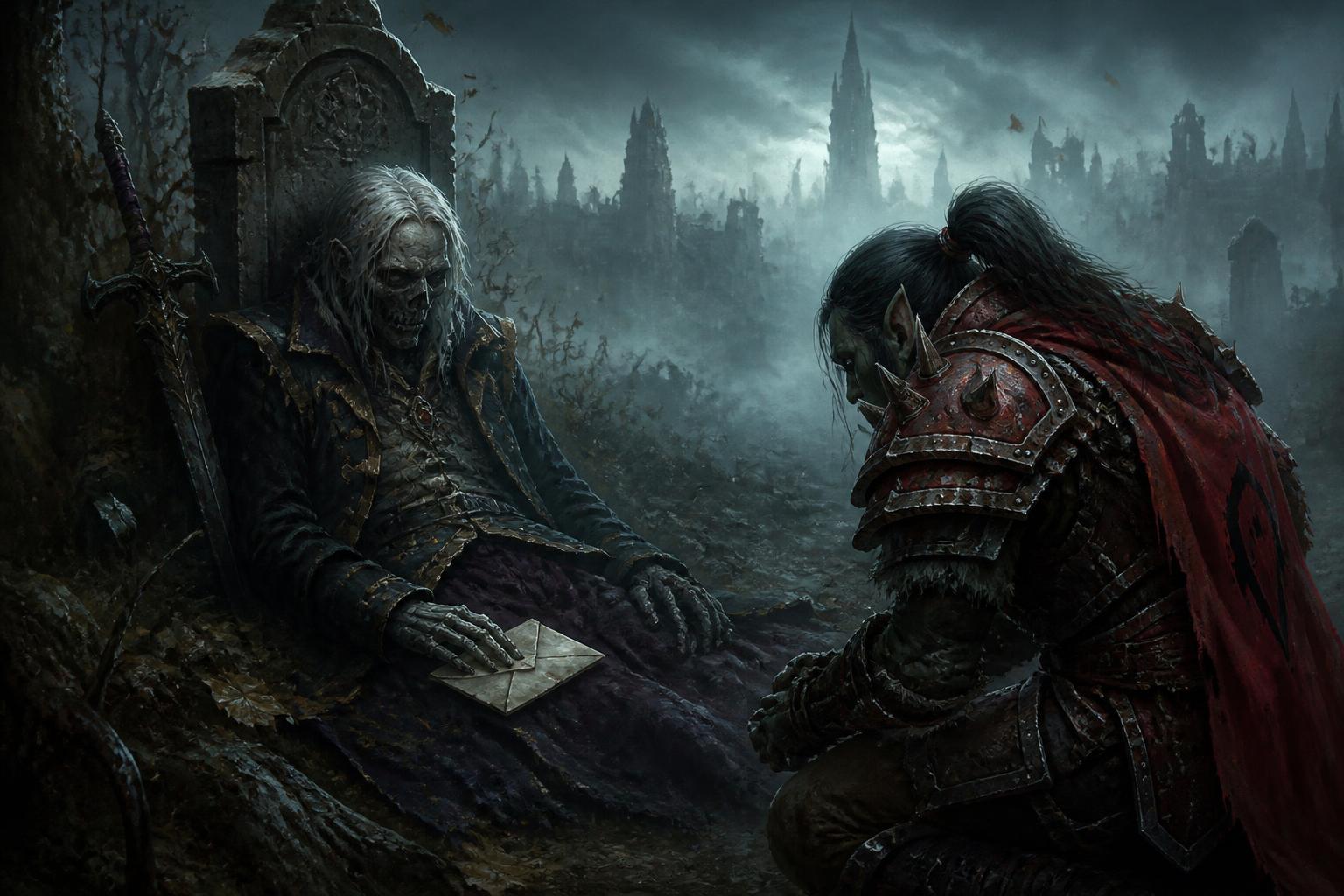
When Edward fails to return from another visit to their ruined home, Tabitha asks Horde adventurers to find him. Near the end of the dungeon, they discover his body beside a letter addressed to his wife.
For Alliance players, that letter opens another part of the story. Jeremy survived and was adopted by Yvette Felwood. After receiving Edward's letter, she promises to share it with Jeremy when he is older.
The complete family story requires both faction perspectives. Tabitha loses her husband without learning that their son survived. Edward dies searching for a child who is alive. Jeremy has another home but does not yet know that his parents continued loving and searching for him after death.
The Wetlands Excavation: Dangerous Discoveries
The excavation site in the Wetlands exposes a prehistoric landscape occupied by dangerous wildlife, Dragonmaw orcs, and ancient Titan constructs. Its story moves from immediate survival to a struggle over discoveries whose significance is not yet understood.
The raptors are a major combat threat, not merely background wildlife. Treating the expedition as a quiet archaeological tour misses the danger that surrounds the surviving explorers. The creatures help establish that this buried landscape has remained hostile regardless of who claims its treasures.
What the Dragonmaw Want
The Dragonmaw encountered here are not members of the playable Horde. They hope discoveries from the excavation will restore their clan's power and win favor with Rend Blackhand, the Dark Horde's ruler at Blackrock Mountain.
Horde adventurers assist a Forsaken Deathstalker by clearing out Dragonmaw forces and recovering intelligence. This gives the expedition a political purpose alongside its archaeological one: valuable discoveries could strengthen a hostile faction.
One quest reward, the Bloody Map, bears damaged dwarvish writing. Its meaning remains unconfirmed. It is worth recognizing as an unresolved curiosity, but there is no established destination or hidden reward to promise from its markings.
The Relic Guardian and the Titan Relic
The final portion involves rescuing expedition survivors and activating the Relic Guardian, an ancient Titan construct that players must then defeat. The recovered Titan relic goes to either the Explorers' League or the Earthen Ring.
The Earthen Ring discovers flashes of ancient history within the relic's light, but understanding those messages requires further study. The conclusion is therefore a discovery rather than a complete revelation: the expedition recovers evidence of the distant past without immediately explaining it.
Dalaran: Containing an Arcane Disaster
With its protective barrier gone, Dalaran is revealed as a city in crisis. Unstable magic, malfunctioning constructs, and hostile creatures threaten its streets and structures. The Council of Six orders a lockdown, but Archmage Vondara seeks outside help.
Alliance adventurers meet her outside the sewer gates and receive a secret invitation to enter. Horde players arrive with a different objective: Magister Vordeen Voidglare sends them to uncover magical secrets previously kept beyond their reach.
Different Motives, Shared Danger
Vondara catches the Horde's attempted infiltration but offers a bargain instead of punishment. The disturbance could threaten the surrounding region, including the Undercity. She allows the intruders through her wards if they help contain it, permitting them to scavenge along the way.
Both factions consequently work toward the same immediate goal without sharing the same loyalties. Cooperation here is practical, not a declaration that their wider conflict has disappeared.
Inside, adventurers encounter necromancers raising undead in the sewers, rogue arcane creatures feeding on loose magic, malfunctioning constructs, and a fel-corrupted ancient. The variety of enemies shows how widely the magical breakdown has spread.
Why the Horde's Looting Plans Fail
Two Horde assignments give the crisis a comic counterpoint. Construct power cores are collected for an apothecary interested in arcane-powered abominations, but the recovered cores are smashed beyond usefulness. A goblin's request for a priceless magical tome instead produces a history book she considers nearly worthless.
These outcomes distinguish quest rewards from the value characters imagine they will recover. Dalaran contains extraordinary magic, but opportunistic scavenging does not automatically produce useful discoveries or valuable merchandise.
The journey culminates at the top of the Violet Citadel, where players confront the Shade of the Archmage. Reaching that confrontation brings the expedition back to its central purpose: containing the disturbance rather than successfully robbing the city.
Planning a Lore-Focused Dungeon Run
For these adventures, preparation is primarily about collecting the relevant quests and leaving room to read. Check the surrounding quest hubs before entering, and distinguish faction-specific objectives from the dungeon's shared story.
- Agree on the pace: a group interested in exploration is better suited to inspecting graves, letters, and quest text.
- Read recovered objects: the Treaty of Understanding and Edward's letter carry more narrative weight than their appearance in a loot window suggests.
- Separate mysteries from confirmed discoveries: the Bloody Map does not have an established explanation here.
- Keep faction limits in mind: the Heartweaver storyline is intentionally incomplete from either side alone.
Keep a modest reserve of WoW Forever gold for ordinary preparation, but do not mistake these story-rich expeditions for a documented farming route. Their clearest rewards are the quests, encounters, and context they add to the world.
Frequently Asked Questions
Can one faction see the whole Heartweaver storyline?
No. Horde quests reveal Edward's search and death, while Alliance quests reveal Jeremy's survival and adoption. Both perspectives are needed to understand the full tragedy.
Does Muradin's tomb mean he is dead?
No. It reflects Ironforge's belief that he died after Arthas claimed Frostmourne. His people do not know he survived.
Does the Bloody Map lead to confirmed treasure?
Its meaning and destination are unconfirmed. Treat it as an unresolved discovery rather than a guaranteed treasure route.
Are the Dragonmaw in the excavation allied with Horde players?
No. These Dragonmaw seek power and Rend Blackhand's favor. Horde adventurers work against them during the expedition.
Why does Vondara allow Horde adventurers into Dalaran?
She needs help containing a magical crisis that could threaten the surrounding region. Entry is conditional on helping address that danger.