
Path of Exile 2 Acolyte Rework: Chaos Explosions, Clones and Darkness
Understand the announced Acolyte changes, their build implications, and the mechanics still awaiting confirmation.
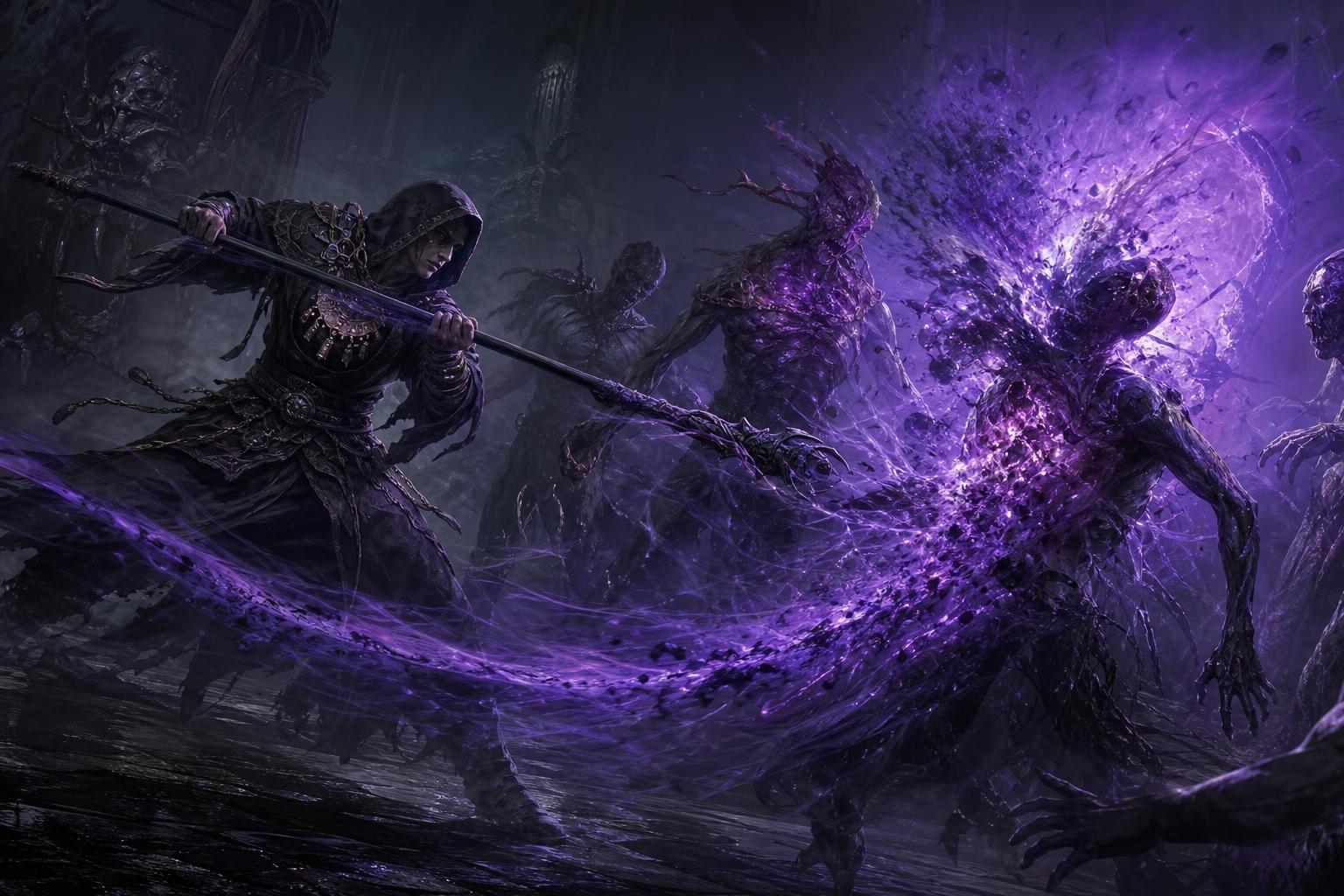
Overview
Path of Exile 2’s announced Acolyte of Chayula rework brings three major changes: a chaos-focused Herald, a quarterstaff-wielding clone, and the relocation of Darkness to the main passive tree. Here is how those features could reshape clearing, defensive decisions, and build planning—and which interactions still need confirmation before committing gear or currency.
What Is Changing for Acolyte of Chayula?
The announcement shifts the Monk Ascendancy toward more visible offensive and utility mechanics. Rather than keeping Darkness as an exclusive defensive option, the rework makes room for a Herald and a companion with an unusual body-transfer ability.
- Herald of Chayula: Hits apply Decay to enemies, with a death explosion based on the amount of Decay accumulated.
- Darkness: The mechanic moves out of the Ascendancy and becomes a keystone on the main passive tree.
- Clone companion: A duplicate can use assigned quarterstaff skills, while a sacrifice-and-transfer mechanic allows the player to continue in its body.
These are announced features rather than a complete numerical balance breakdown. Exact scaling, restrictions, and interactions remain important unknowns. The clearest conclusion is that Acolyte gains new ways to approach packs and dangerous situations, not that every existing build automatically becomes stronger.
Herald of Chayula Adds Decay-Based Explosions
How the announced Herald works
Herald of Chayula causes hits to add Decay to monsters. When an affected monster dies, it explodes based on the amount of Decay it had accumulated. That gives the mechanic two connected stages: applying Decay before death, then turning the kill into an explosion.
The feature is presented as a chaos-focused addition to the Ascendancy. Its appeal is straightforward: damage dealt while fighting a pack can contribute to a payoff when an enemy falls. For an Ascendancy already associated with chaos damage, that is a natural thematic fit.
However, the announcement does not establish the complete scaling rules. Exact application restrictions, explosion damage, and interactions with other effects need full skill wording or testing. In particular, players should not assume that explosions can repeatedly trigger themselves.

What it could mean for clearing
A death explosion offers a potential improvement to pack clearing, especially when enemies are grouped closely enough for the payoff to matter. The practical question is whether a build can accumulate meaningful Decay while still killing enemies efficiently.
Combining the new effect with another Herald is an appealing possibility, including setups that mix chaos and lightning damage. That remains a planning direction rather than a finished recommendation: reservation requirements, damage compatibility, and trigger restrictions determine whether a combination is worthwhile.
For players managing a PoE 2 currency budget, the sensible approach is to keep equipment useful beyond one untested interaction. Avoid paying a premium for narrowly specialised modifiers until the final mechanics establish what actually scales the Herald.
Darkness Moves to the Main Passive Tree
A defensive option beyond one Ascendancy
Moving Darkness to a keystone is significant because it separates the mechanic from Acolyte’s Ascendancy-point choices. Other characters can potentially consider it through the main passive tree, subject to its position and final wording.
Darkness has functioned as an additional protective resource, absorbing damage before underlying resources and recovering reserved portions after a delay. Its substantial trade-off has been the loss of Spirit, which normally supports persistent buffs, minions, and other reservation-based skills.
That trade-off explains why Darkness is not simply a free defensive upgrade. A character must compare the protection it offers against everything lost by giving up Spirit. A setup heavily dependent on persistent skills may face a very different decision from one with fewer reservation needs.
Take a look at: broader build balance and character changes
What to check before building around it
- Passive-tree position: Travel investment can determine whether the keystone is practical.
- Final defensive values: Capacity and recovery behaviour decide how dependable the protection is.
- Spirit restrictions: Existing reservation plans may need substantial changes.
- Specific damage interactions: Do not assume every self-damage or damage-over-time setup behaves identically.
For Acolyte, the relocation creates a different kind of flexibility: new Ascendancy features no longer need to compete with Darkness in the same way. Whether taking the keystone alongside those features is efficient depends on the final tree and the character’s defensive priorities.
The Clone Adds Quarterstaff Skills and Body Transfer
A companion with a weapon-specific role
The announced clone can use quarterstaff skills assigned to it. That restriction matters: the companion should not be treated as a universal duplicate capable of using any attack or spell a character equips.
Quarterstaff builds therefore have the most obvious connection to the new mechanic. Even so, its contribution will depend on details such as skill access, action frequency, targeting, and resource handling. A visually impressive companion is not enough to determine its actual damage or utility.
Continuing in the clone’s body
The second part of the feature allows the character to sacrifice their body and continue in the clone’s body. Another clone is created after a short time, giving the mechanic a repeatable structure rather than presenting it as a permanently consumed companion.
This suggests a potentially valuable escape or repositioning tool. If the clone occupies a safer location, transferring to it could help leave a dangerous position. But it should not be assumed to provide automatic death prevention: activation rules, timing, and availability are not fully established by the announcement.
Culling Palm and Flicker Strike remain testing ideas
Culling Palm and Flicker Strike create interesting possibilities for movement-oriented setups. A clone using a mobile skill could potentially provide useful positioning, while charge-related interactions might affect follow-up attacks.
The key word is potentially. Whether the clone generates Power Charges, who receives them, and whether it can consume them are unresolved questions. Those details separate a functional movement setup from an attractive theory.
Before investing Divine Orbs in a specialised quarterstaff, verify the companion’s charge ownership and skill behaviour. A weapon that improves the player’s established attacks is a safer purchase than one valued entirely for an unconfirmed clone interaction.
What the Rework Means for Existing Builds
The announcement focuses on new features and the relocation of Darkness. It does not provide a complete account of changes to the Ascendancy’s existing flame and leech mechanics. Their absence from the reveal is not proof that their values or wording remain untouched.
Existing characters should therefore review the rework in stages:
- Check which Ascendancy choices have changed and what must be replaced.
- Assess whether Herald of Chayula supports the build’s actual damage pattern.
- Determine whether the clone contributes useful skills or positioning.
- Recalculate defenses if Darkness was central to survival.
- Only then commit to expensive equipment or passive-tree changes.
The broader implication is greater separation between offensive identity and defensive choice. Chaos explosions and a clone become prominent reasons to choose Acolyte, while Darkness becomes a wider character-building consideration.
That distinction also helps with Path of Exile 2 currency planning. Spend first on equipment that keeps the character functional, then refine around confirmed interactions rather than speculative combinations.
Frequently Asked Questions
Does Herald of Chayula make enemies explode?
Yes. The announced mechanic applies Decay through hits and causes affected monsters to explode on death, with the explosion based on accumulated Decay. Full scaling details still need confirmation.
Is Darkness being removed entirely?
No. It is being moved from Acolyte of Chayula to a keystone on the main passive tree, opening it to other character builds.
Can the clone use any skill?
The announcement specifically describes quarterstaff skills. It does not establish support for arbitrary weapon attacks or spells.
Does the clone share Power Charges with the player?
That interaction is not confirmed. Builds involving charge generation, Culling Palm, or Flicker Strike should wait for exact wording and testing.
Should existing Acolytes replace their gear immediately?
No. First confirm the final Ascendancy nodes, defensive requirements, and skill interactions. Broadly useful upgrades are less risky than expensive items purchased for an unverified combination.